ZeroMQ Request/Reply Component
Component: bmforge.zmq-server · Contract: 0.4.0 (draft) · Architecture view: first draft
Start here: Use cases · Analysis · Design · Code · Traceability
This is the human-facing map of the ZeroMQ REQ/REP component. It shows what it does, what is responsible for what, and where to inspect the implementation. The complete technical contract remains authoritative for Codex, including the approved modules, TCP/IPC rules, error handling and acceptance checks.
From behaviour to code
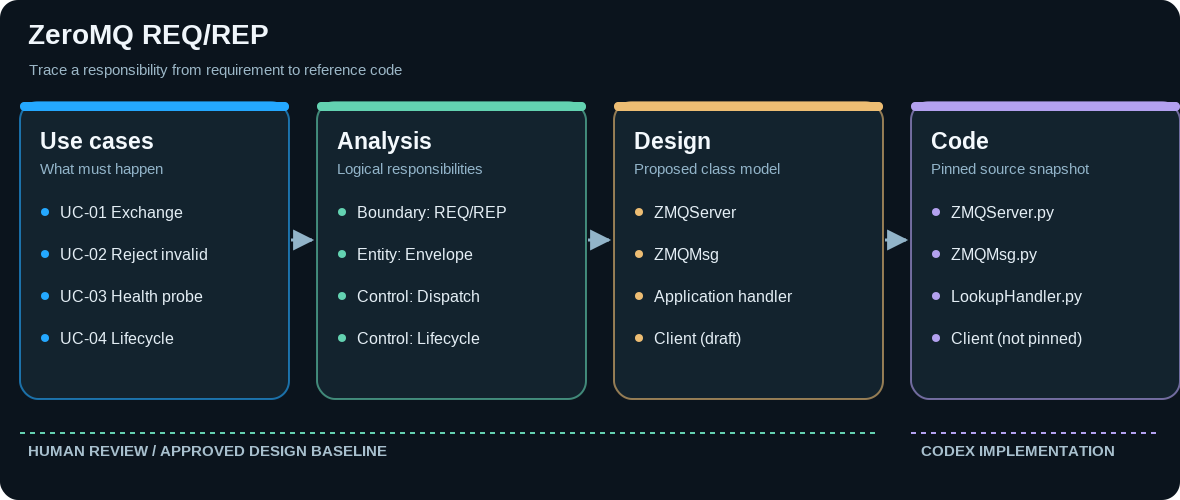
The human approves the use cases and design. Codex implements within that baseline. Code is inspectable but does not need line-by-line human approval. The class model below is provisional: it describes the existing contract and reference code, not an approved new implementation.
Use cases
| ID | Actor and goal | Success / failure |
|---|---|---|
| UC-01 | Application client exchanges a command or query. | One versioned JSON request gets one correlated reply, within a bounded timeout. |
| UC-02 | Application client sends invalid or unsupported input. | Structured error returned; the listener remains usable. |
| UC-03 | Health probe checks the existing endpoint. | health returns ok, or a bounded failure when unavailable. |
| UC-04 | Service owner starts, stops or reconfigures the listener. | Bind readiness and failures are visible; TCP or protected local IPC is selected; shutdown releases the socket. |
These are summaries, not replacement acceptance criteria. See contract checks 1–10.
Analysis model
Problem-space responsibilities, independent of Python classes:
| Role | Responsibility |
|---|---|
| Boundary: Request/reply | Accept one framed request and return one response; enforce the message/transport boundary. |
| Entity: Message envelope | Carry the protocol version, sender, target, method and payload. |
| Control: Dispatch | Route a validated request to an application-owned operation. |
| Control: Lifecycle | Establish readiness, report worker failure and stop cleanly. |
These are logical roles, not a requirement to create four Python classes. They follow BMForge’s Activity / Interface / Entity classification.
Design model
Solution-space classes, subject to your design review:
| Design element | Responsibility and boundary | Reference |
|---|---|---|
ZMQServer (interface) |
Own the REP socket and worker thread; poll, reply, signal readiness/failure and clean up. | ZMQServer.py |
ZMQMsg (entity) |
Serialize, parse and validate the versioned JSON envelope. | ZMQMsg.py |
| Application handler (activity) | Interpret supported methods and perform application-specific work. Outside the reusable transport. | LookupHandler.py example |
| Application client (interface) | Send a bounded REQ, receive the reply, and handle timed-out exchanges. | Draft: no pinned client snapshot yet. |
Design decisions, not extra classes: endpoint configuration selects TCP or a named IPC path; deployment owns IPC permissions and the single-server lifecycle. The application owns method names, authorisation and payload schemas. None of the draft names above expands the approved runtime module inventory.
Request/reply interaction
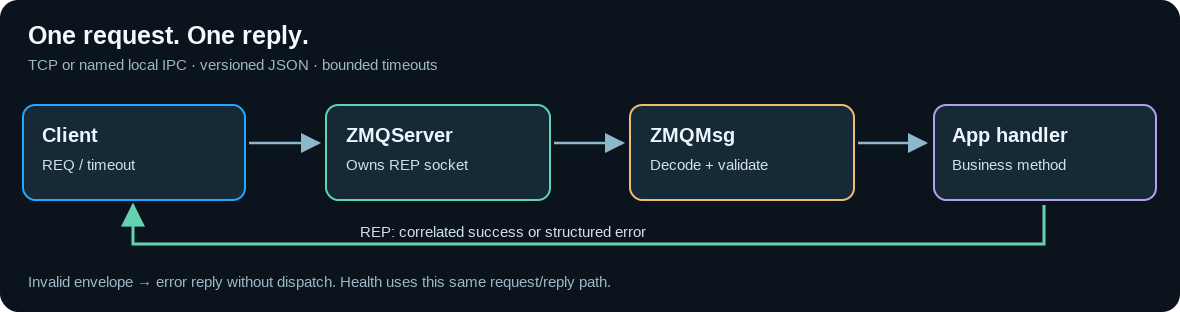
The same message contract applies to TCP and IPC. Malformed requests must receive an error instead of silently breaking the REP worker. A health probe uses the same endpoint, not an additional server.
Implementation and source
This is a frozen BMGeoIP reference snapshot, not a full compliant implementation or a runtime BMForge dependency. Codex adapts the transport into each consuming application.
- Socket worker:
ZMQServer.py - Message envelope:
ZMQMsg.py - Application dispatch example:
LookupHandler.py - Protocol/timeouts example:
DZMQ.py - Codex component skill
The snapshot predates parts of contract 0.4.0; it is not evidence that every acceptance check passes. Current consuming applications must supply and test any missing behaviour.
Traceability
| Use case | Analysis responsibility | Design element | Verification |
|---|---|---|---|
| UC-01 | Boundary + envelope + dispatch | ZMQServer, ZMQMsg, handler, client |
Checks 1, 6, 8 |
| UC-02 | Boundary + envelope | ZMQMsg, ZMQServer |
Checks 2–4 |
| UC-03 | Boundary + dispatch | ZMQServer, app handler |
Check 7 |
| UC-04 | Lifecycle + boundary | ZMQServer, app configuration |
Checks 5, 6, 9, 10 |
Open the full acceptance checks · Engineering contract
Next iteration: clickable class-level graph, contextual descriptions on selection, consuming-project code links and test-result links. This draft deliberately avoids adding a new viewer, framework or runtime dependency.